





EXTREME 5089
Ultralight Men's Long-Sleeve Trail Running Shirt with Raw-Edge Hem
€60,00
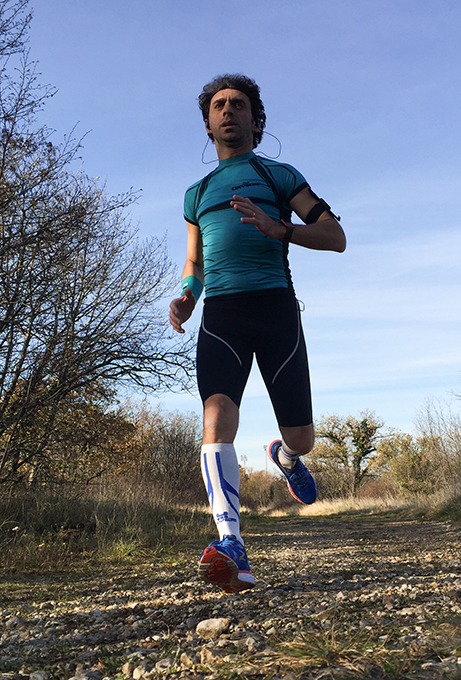
Let’s take a look at some of the characteristics that distinguish running on pavement from running on dirt trails—perhaps debunking a few myths along the way—and offer some “tips” on how to tackle uneven terrain

Let’s set aside the extreme off-road trails—the kind suited for roe deer and experienced trail riders—and focus on what’s known as “compact” terrain: we’re talking about the trails that wind through the countryside and hills or climb up into the mountains. This terrain is uneven, but not too much so, consisting mostly of compacted dirt and/or rocks: this is the type of trail that most closely resembles asphalt, though it certainly doesn’t offer the same grip. And it’s precisely when talking about grip that you realize how trail running isn’t really about speed: the ground absorbs more energy and doesn’t have the same elasticity. Furthermore, running on dirt trails often involves tackling uneven climbs and equally uneven descents that must be navigated with caution… and, therefore, more slowly than on asphalt.
Dirt trails, therefore—even compact ones—are effective for strength training, as they challenge and strengthen the ankles and knees, as well as the entire musculature of the body. The quintessential training element of natural cross-country terrain is the presence of continuous changes in elevation: uphill and downhill sections, slight inclines, and flat stretches are, in fact, extremely effective for training, allowing for a “natural” Fartlek workout.
This doesn’t mean that a runner can’t try their hand at some trail running; they just need to be aware that they’re doing it to build muscle and/or relax by immersing themselves in a natural setting, far from the traffic, smog, and chaos of our cities… and certainly not to improve their speed performance. For that, however, they should find a route that alternates between compact dirt trails and asphalt, with climbs, flat sections, and descents…
Running on dirt roads, therefore, leads to a natural increase in your average pace per kilometer. While for a professional runner this increase might be two to ten seconds per kilometer, for a novice amateur it can easily be thirty to forty seconds slower than the normal average on pavement. Of course, you’ll improve with experience and training, but it’s important to realize that you can’t expect the same pace on pavement as on dirt, even when running on flat terrain!
Running on dirt roads—even on flat terrain—is more tiring than running on asphalt because of the limited traction, which is even more noticeable when going uphill. But the real challenge on natural terrain is the downhills: pay close attention to what you’re doing, don’t get carried away by the excitement, and stay focused… Downhill sections on trails are not your friend, unlike on asphalt. Falling on rocks while going downhill is dangerous and can lead to serious injuries!
That said, run wherever, however, and whenever you like! And above all, have fun! Because you don’t necessarily have to set a personal best every time you go out for a run… and besides, a nice run through nature is absolutely enjoyable and relaxing.
Share: